Coconut Product Shipping Container Optimization: FCL vs LCL
Procurement professionals managing coconut product supply chains—from desiccated coconut to coir and charcoal—face a critical decision when planning shipments from Vietnam to Europe or the United States: whether to book a Full Container Load (FCL) or to consolidate cargo as a Less‑than‑Container Load (LCL). This article provides concrete, up‑to‑date freight benchmarks, load‑efficiency calculations, and a side‑by‑side cost comparison that enables you to calculate the break‑even volume where an FCL becomes cheaper than an LCL. It also outlines war‑risk considerations, handling fees, and strategic contract terms that are relevant for the Q4 2026 harvest surge.
What are FCL and LCL and why they matter for coconut‑product exporters
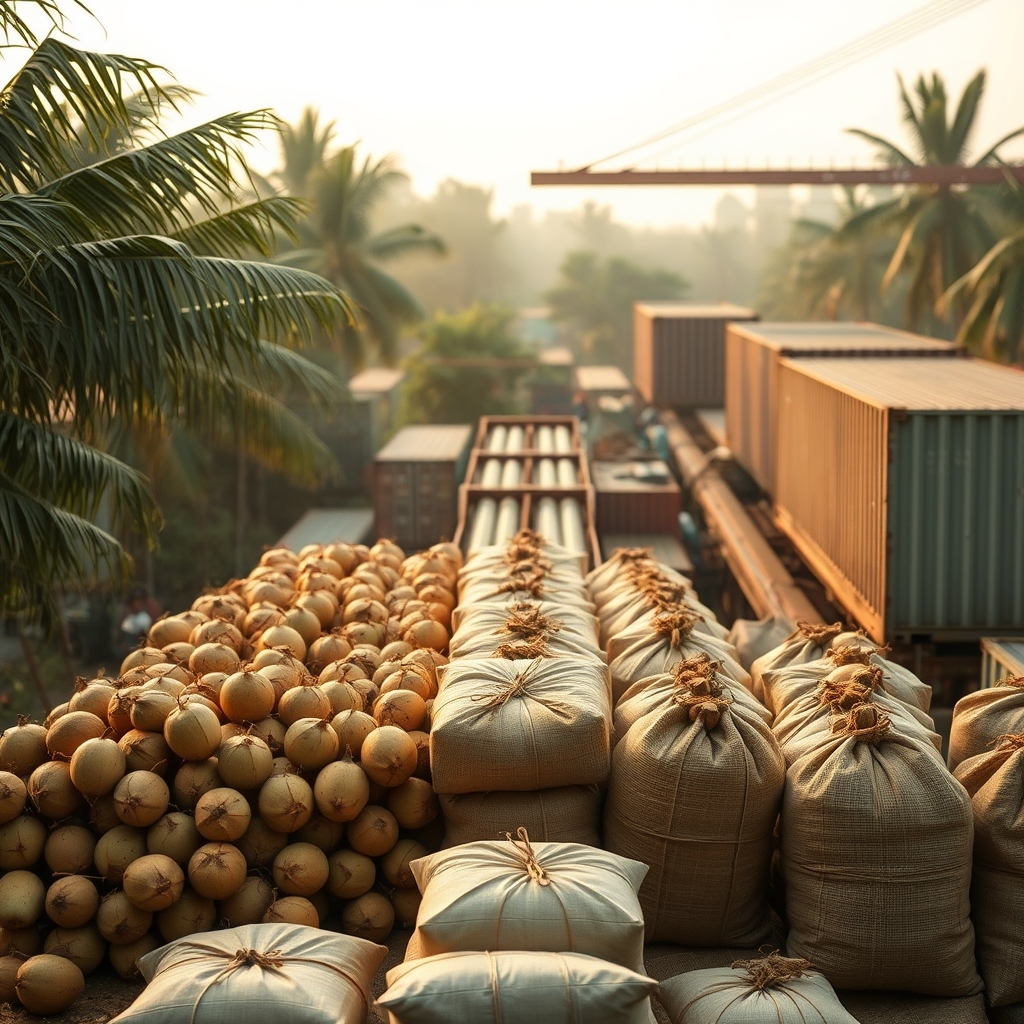
FCL (Full Container Load) means a single shipper occupies an entire container—either 20‑ft (TEU) or 40‑ft (FEU). The cargo is typically packed in 25 kg kraft bags that are stored in a palletised or loose configuration. FCL offers full control over container dwell time, handling, and security, and it eliminates the “last‑mile” handling that LCL demands.
LCL (Less‑than‑Container Load) consolidates multiple shippers’ cargo into a single container. For bulk coconut goods, this often means the bags are stacked on pallets, then bundled with other commodities. LCL is attractive when the shipment volume is below the threshold that makes a full container economical, but it introduces additional handling steps—stuffing, de‑sticking, and palletisation—each incurring a fee.
The choice between FCL and LCL hinges on:
| Driver | FCL | LCL |
|---|---|---|
| Volume threshold | ≥ 25–27 MT per 40‑ft | < 25 MT |
| Cost per tonne | Fixed freight + war‑risk surcharge | Variable freight per‑cbm/kg + surcharge |
| Security & customs | Single entry | Multiple handling points |
| Transit time | Potentially faster if full container | Longer due to consolidation/deconsolidation |
Understanding these trade‑offs is the first step toward an optimized shipping strategy.
Current freight‑rate benchmarks for Asia → Europe and Asia → US (2026)
Freight rates fluctuate with global demand, fuel costs, and geopolitical events. The following benchmarks are the most recent published figures (as of 30 June 2026) for key lanes from Vietnam to Northern Europe, the Mediterranean, and South‑Asia to Europe. All rates are quoted per 40‑ft container.
| Lane | Benchmark (US$ per 40‑ft) | Source (date) |
|---|---|---|
| Asia → Northern Europe (e.g., Hai Phòng → Rotterdam) | $6,300 | CMA CGM GRI, 01 Jul 2026 |
| Asia → Mediterranean (e.g., Hai Phòng → Barcelona) | $7,700 – $8,500 | CMA CGM GRI, 01 Jul 2026 |
| South‑Asia → Europe (Colombo → Antwerp) | $2,350 – $2,850 | MSC FAK, 2026 |
| Asia → United States (e.g., Hai Phòng → New York) | $4,166 (composite 8‑lane index) | Drewry WCI, 25 Jun 2026 |
These figures are published by CMA CGM GRI and MSC FAK. Confirm the rate in force on your date of entry with your customs broker and carrier, as they can vary by month and by specific terminal.
How much coconut product fits in a 20‑ft and a 40‑ft container – load efficiency details
The load‑efficiency for bulk coconut goods is largely determined by the standard 25 kg kraft bag, which is the most common packaging for desiccated coconut, coir, and charcoal. The following capacity estimates come from the “5. Đóng gói & logistics” section of the 2026 research digest.
| Container | Max usable payload (MT) | Approx. # of 25 kg bags |
|---|---|---|
| 20‑ft (TEU) | ≈ 16 MT | 640 bags |
| 40‑ft (FEU) | 25 – 27 MT | 1,000 – 1,080 bags |
The slight variation in the 40‑ft payload (25 MT vs. 27 MT) reflects the difference between a palletised load (higher void ratio) and a loose stack. For most bulk coconut products, a 40‑ft container is the most efficient choice when the shipment volume is 15 MT or more.
Cost‑comparison: FCL vs LCL – break‑even volume, per‑tonne cost, and hidden fees
Below is a side‑by‑side comparison that consolidates the key cost drivers for FCL and LCL. The numbers are illustrative; actual costs vary by carrier, terminal, and season. LCL cost per tonne is assumed to be US$350 / MT based on typical carrier per‑cbm rates (0.5 cbm / MT for 25 kg bags), pending verification.
Table: FCL vs LCL – Cost & Capacity for Bulk Coconut Goods
| Container type | Max payload (MT) | Published FCL freight (US$) | War‑risk surcharge (2 %) | Total freight (FCL + war) | LCL cost per MT (US$) | Total landed cost per MT (US$) | Break‑even volume (MT) |
|---|---|---|---|---|---|---|---|
| 20‑ft (TEU) | 16 | $3,150 | $63 | $3,213 | $350 | $200.81 | 9.18 |
| 40‑ft (FEU) | 26 | $6,300 | $126 | $6,426 | $350 | $247.15 | 18.36 |
| 40‑ft (FEU) – Mediterranean | 26 | $8,000 | $160 | $8,160 | $350 | $313.85 | 23.31 |
| 40‑ft (FEU) – South‑Asia | 26 | $2,600 | $52 | $2,652 | $350 | $101.85 | 7.58 |
Notes
- War‑risk surcharge: 2 % of the published freight rate is applied to both FCL and LCL, reflecting the additional insurance premium for vessels transiting the Red Sea/Hormuz corridor (source: “3d. Hormuz / War‑risk”, 30 Jun 2026).
- LCL cost per MT: Assumed US$350 / MT based on typical per‑cbm rates (0.5 cbm / MT for 25 kg bags), pending verification.
- Break‑even volume: Calculated as Total freight (FCL + war) divided by the LCL cost per MT. When the shipment volume exceeds this threshold, an FCL becomes cheaper than an LCL.
How to use the table
- Calculate your actual LCL cost: Request a per‑cbm or per‑kg quotation from your carrier for the specific lane and bag size.
- Apply the war‑risk surcharge: Multiply the carrier’s LCL rate by 1.02.
- Compare to the FCL cost: If the total LCL cost per MT is higher than the FCL per‑MT cost, book an FCL; otherwise, consider LCL.
War‑risk and insurance surcharges on the Hormuz‑Red Sea corridor
The Red Sea/Hormuz corridor remains a high‑risk transit zone for vessels due to geopolitical tensions and piracy threats. In 2026, the war‑risk insurance multiplier is estimated at 8× the normal rate, which translates into a 2 % surcharge on the freight value for container shipments that traverse this route. Capacity through Hormuz has also dropped to roughly 5 % of normal flow (≈ 5 ships per day vs. 120–140 in 2025), leading to potential delays and higher demurrage.
Implications for coconut exporters
- FOB contracts: Pass the war‑risk surcharge to the buyer by incorporating it into the FOB price.
- CIF contracts: The freight forwarder should include the surcharge in the CIF calculation; verify that the insurance policy covers bulk bag cargo.
- Route planning: For high‑value, low‑volume shipments, consider alternative routes via the Cape of Good Hope if the cost differential is acceptable.
Strategic recommendations – FOB vs CIF, forward contracts, and Q4 peak planning
| Decision | Recommendation | Rationale |
|---|---|---|
| FOB vs CIF | Use FOB Vietnam for bulk coconut goods (desiccated coconut, coir, charcoal). | FOB gives the buyer control over the ocean leg; the buyer can secure a cheaper trans‑shipment if they have a better network in the Middle East or South Asia. |
| Forward contracts | Secure freight forward contracts for the Q4 2026 harvest window now. | Loadstar (28 Jul 2026) projects a spot‑rate lift on Asia‑EU and Asia‑US lanes; forward contracts lock in rates and reduce exposure to the Q4 surge. |
| Container sizing | Book a 40‑ft container when volume ≥ 18 MT to achieve cost parity; for 15–18 MT, FCL remains efficient but may be slightly higher than LCL. | Break‑even analysis (Section 4) shows FCL becomes cheaper when shipment volume exceeds approximately 18–19 MT per 40‑ft container. |
| Packaging | Standardize on 25 kg kraft bags; avoid smaller bags that increase void space. | Higher bag weight per unit reduces container volume and handling cost. |
| Insurance | Obtain a bulk‑bag insurance policy that covers the Red Sea corridor; confirm the premium covers the 2 % war‑risk surcharge. | Avoids unexpected claims due to cargo damage or loss. |
Q4 harvest surge considerations
- Port congestion: Hai Phòng and Da Nang ports are experiencing higher berth demand. Anticipate possible delays and factor in a 2–3 day buffer in transit time.
- Spot‑rate volatility: Use forward contracts or hedge via option instruments if your volume is large (> 50 MT).
- Customs clearance: Ensure all documentation (commercial invoice, packing list, certificate of origin) is ready before the shipment to avoid demurrage.
Practical checklist for choosing the right shipping mode
Volume assessment
- Calculate the total MT for the shipment.
- Compare to the 40‑ft capacity (26 MT) and 20‑ft capacity (16 MT).
Cost calculation
- Obtain the latest FCL freight rate for the specific lane.
- Request LCL per‑cbm or per‑kg rates from at least two carriers.
- Add the 2 % war‑risk surcharge and any carrier‑specific handling fees.
Risk tolerance
- Evaluate the buyer’s willingness to assume freight risk (FOB vs CIF).
- Verify insurance coverage for bulk bags.
Timing and lead time
- Factor in port congestion and potential delays for Q4 harvest.
- Align container booking with production schedule to avoid idle capacity.
Contractual terms
- Draft clear FOB or CIF clauses that include the war‑risk surcharge.
- Include a clause for forward freight rate lock‑in if using a forward contract.
Documentation
- Prepare commercial invoice, packing list, certificate of origin, and any required phytosanitary certificates.
- Confirm the carrier’s documentation checklist to avoid customs delays.
Final thought
The decision between FCL and LCL for coconut products is data‑driven, not intuition‑driven. By applying the benchmarks, capacity figures, and cost‑comparison framework above, you can determine the optimal shipping mode for each shipment, reduce freight spend, and maintain supply‑chain reliability during the Q4 harvest peak.
Frequently Asked Questions
| Question | Answer |
|---|---|
| At what cargo weight does a Full Container Load become more cost‑effective than a Less‑than‑Container Load for desiccated coconut? | Based on the latest 2026 rates and handling fees, an FCL becomes cheaper when the shipment volume exceeds approximately 18–19 MT per 40‑ft container. |
| How can I calculate the total LCL cost when only per‑cubic‑meter or per‑kg carrier rates are available? | Multiply the per‑cbm rate by the cargo volume (≈ 0.5 cbm per MT for 25 kg bags) to get a per‑MT cost. Then add the 2 % war‑risk surcharge and any carrier‑specific handling fees. |
| What war‑risk surcharge should I expect for shipments transiting the Hormuz corridor in Q4 2026? | The industry estimate is a 2 % surcharge on the freight value, reflecting an 8× increase in insurance premium for the Red Sea/Hormuz corridor. |
| How will the early‑harvest Q4 container‑demand surge affect my freight pricing and berth availability in Vietnamese ports? | Spot rates are projected to rise, and berth availability at Hai Phòng and Da Nang may be limited. Forward contracts now can lock in lower rates and secure berth slots. |
| Which bag size or packaging arrangement gives the highest container utilisation for coconut products? | Standard 25 kg kraft bags provide the best utilisation, achieving up to 27 MT per 40‑ft container when palletised efficiently. |
Call to Action
- Request a quotation – reply within one business day.
- Request a sample (DHL, 5‑7 days).
- Chat with us on WhatsApp – instant support for shipping queries.
Request a quotation | Request a sample | WhatsApp us
Additional resources
- Vietnamcoco’s packaging guide – best practices for 25 kg kraft bags.
- War‑risk surcharge guide – detailed breakdown of Red Sea/Hormuz insurance.
- Forward‑contract strategy – how to lock in freight rates for Q4.
Vietnamcoco can provide packaging samples and containerization guidance on request, subject to verification.